REMEMBER: TOXIC WORK CULTURE DOES NOT DESCRIMINATE. TOMORROW IT CAN BE USED AGAINST YOU. BE AN ALLY — OFFER A HAND TO YOUR FELLOW MEMBER

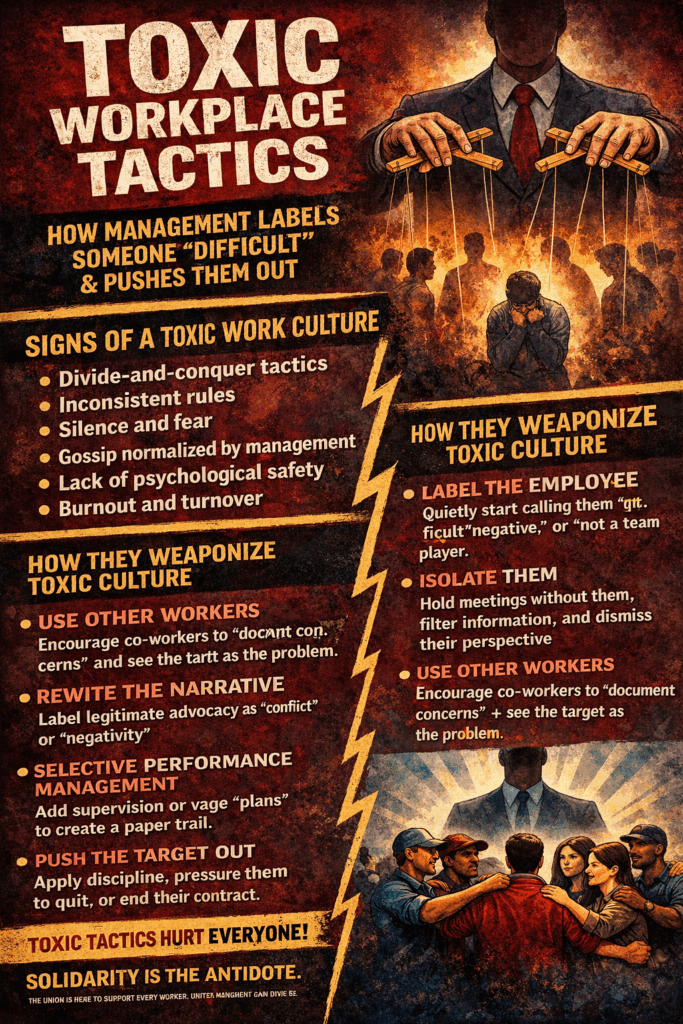
Signs of a Toxic Work Culture
Divide-and-conquer tactics: Employees are encouraged—directly or indirectly—to take sides against one another
Inconsistent rules: Policies are applied differently depending on who the employee is
Silence and fear: Workers stop speaking up because they fear retaliation or being labeled
Gossip normalized by management: Concerns about an employee are shared informally instead of addressed transparently
Lack of psychological safety: Questioning decisions is treated as defiance, not engagement
Selective enforcement: Only certain people are scrutinized, monitored, or “managed”
No clear performance standards: Expectations shift, making it impossible to “do it right”
Burnout and turnover: High stress, disengagement, and people leaving quietly
How Employers Weaponize Toxic Culture to Push Someone Out
This is a well-documented pattern in unionized and non-union workplaces:
1. Labeling the Employee
The employer quietly applies labels such as:
“Difficult”
“Not a team player”
“Negative”
“Resistant to change”
These labels are subjective, not evidence-based.
2. Isolating the Employee
Meetings happen without them
Information is withheld
Their perspective is dismissed or minimized
Isolation makes the employee appear “out of sync” with the team.
3. Using Colleagues (Often Unknowingly)
Instead of direct discipline, the employer:
Encourages coworkers to “document concerns”
Frames the employee as the source of team tension
Positions management as the “mediator” between staff
Colleagues may believe they are helping, not realizing they are being used as tools.
4. Rewriting the Narrative
Legitimate actions are reframed as:
Advocacy → “conflict”
Boundary-setting → “attitude”
Raising safety issues → “negativity”
Asking questions → “insubordination”
The focus shifts from management behavior to the employee’s “personality.”
5. Selective Performance Management
The employer introduces or revives tools such as:
Sudden performance reviews
Increased supervision
“Coaching” plans with vague goals
This creates a paper trail designed to justify removal, not improvement.
6. Pushing the Employee Out
Eventually, the employee is:
Disciplined
Pressured to resign
Non-renewed
Transferred or marginalized
Management claims the outcome was “inevitable” or “supported by the team.”
Why This Harms Everyone
Even employees who are not targeted suffer because:
Trust between coworkers erodes
Fear replaces collaboration
Solidarity breaks down
Anyone could be next
A toxic culture survives only when workers are divided
What can you do
Always be an ally – Employer looks after its interests ALWAYS and ONLY.
Talk to your Union – we bring members together
Follow the formal process: Health and safety – CUPE 4891 – this ensures transparency and accountable follow up and you are protected